Free MIDI Piano Songs Library & Falling Notes Practice Guide
RoxyPiano comes pre-loaded with 22 beloved classical, anime, and contemporary piano MIDI pieces—plus unlimited custom .mid file uploads. Open the Library modal, pick a song, slow down tricky sections by ±1 BPM, separate hands, and master every measure with Wait Mode and Split Sustain.
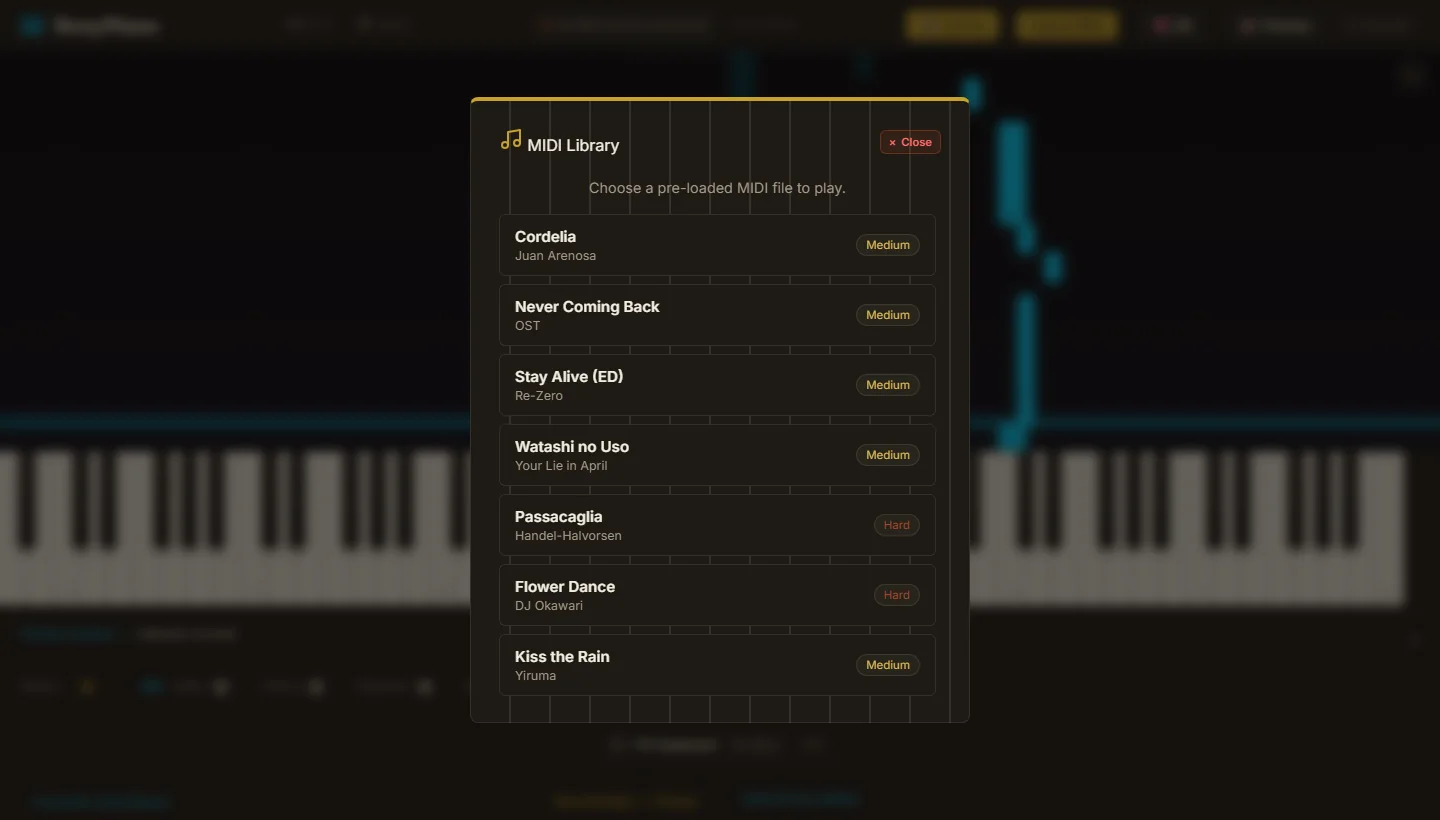
Built-In Free MIDI Song Library (Ready to Play Instantly)
Every piece below is included inside RoxyPiano with zero download required. Click the Library button in the top header to load any track onto the falling-notes canvas immediately.
| Song Title | Composer / Origin | Difficulty | Recommended Practice Tip |
|---|---|---|---|
| Romantic Homicide | d4vd | Easy | Great beginner pop ballad—use Wait Mode at 0.75x speed to master clean left-hand bass octaves beneath the vocal melody. |
| Waltz in A Minor (Easy) | Frédéric Chopin | Easy | Ideal first Chopin piece: practice the 3/4 waltz pulse with the metronome set to 3/4 (Strong–Normal–Normal accent). |
| La Campanella (Easy) | Franz Liszt | Easy | Accessible introduction to Liszt’s famous bell motif—focus on light wrist staccato on the repeated high D# notes. |
| River Flows in You | Yiruma | Medium | Yiruma’s iconic anthem: drill the flowing sixteenth-note chorus runs in 2-bar A–B loops before raising speed from 0.75x to 1x. |
| Kiss the Rain | Yiruma | Medium | Ideal showcase for Salamander Grand Piano V3 dynamics—use gentle velocity and smooth sustain pedal changes on every chord. |
| Idea 10 | Gibran Alcocer | Medium | Fast broken-chord pattern at 170 BPM—start at 0.5x speed with Right/Left hand separation to lock in smooth finger crossings. |
| First Step (Interstellar) | Hans Zimmer | Medium | Build cinematic crescendo gradually using Salamander V3 velocity dynamics and clean sustain changes every two bars. |
| Nuvole Bianche | Ludovico Einaudi | Medium | Einaudi’s signature arpeggio piece—keep the left-hand rolling pattern steady with Split Sustain (Right or All) and gentle touch. |
| I Giorni | Ludovico Einaudi | Medium | Practice the lyrical repeating rhythmic cell at 0.75x speed, emphasizing the top soprano note of every right-hand chord. |
| Cordelia | Juan Arenosa | Medium | Focus on balanced left-hand arpeggios at 0.75x speed before bringing the expressive right-hand melody up to tempo. |
| Watashi no Uso | Your Lie in April | Medium | Slow the delicate intro to 0.5x–0.75x and enable A–B Loop on flowing left-hand accompaniment patterns. |
| Stay Alive (ED) | Re-Zero | Medium | Great anime ballad for Wait Mode—practice the chorus melody with Right Hand solo first, then combine both hands. |
| Never Coming Back | OST | Medium | Use Right-Hand Split Sustain (Split Point C4) to keep emotional sustained chords clear without muddying bass octaves. |
| Nocturne No. 20 in C# Minor | Frédéric Chopin | Medium | Expressive C# minor showcase: isolate the delicate ornamental scales in Wait Mode before adding rubato phrasing. |
| Nocturne Op. 9 No. 1 in B♭ Minor | Frédéric Chopin | Hard | Romantic polyrhythm challenge—use Left Hand solo first to internalize the rolling 6/4 accompaniment before layering right-hand runs. |
| Nocturne Op. 55 No. 1 in F Minor | Frédéric Chopin | Hard | Master the solemn march-like opening bass before speeding up the dramatic triplet chord climax using ±1 BPM increments. |
| Waltz in C# Minor, Op. 64 No. 2 | Frédéric Chopin | Hard | Contrast the melancholic opening against the brisk più mosso section using A–B Loop on the flowing eighth-note runs. |
| Experience | Ludovico Einaudi | Hard | Relentless rhythmic build: start at 0.75x with the metronome enabled so the driving left-hand ostinato stays rock-solid. |
| Flower Dance | DJ Okawari | Hard | Practice the iconic syncopated intro using the Advanced Metronome eighth-note subdivision before playing at 1x speed. |
| Passacaglia | Handel-Halvorsen | Hard | Demanding Baroque-romantic variations: drill rapid runs in 4-bar A–B loops with ±1 BPM tempo increments. |
| Happy Birthday (Chopin & Liszt Style) | Classical Arrangement | Hard | Virtuoso party showcase—drill the sweeping Lisztian arpeggio cadenzas at 0.5x speed in Wait Mode before performing at tempo. |
| La Campanella (Hard) | Franz Liszt | Hard | Concert-level octave leaps (4,300+ notes): practice 2-bar sections at 0.5x speed with Wait Mode to build pinpoint leap accuracy. |
The 4-Step Falling Notes Practice Method
-
Isolate One Hand First (Right / Left)
In Practice Mode, switch Hand to Right or Left and set Speed to 0.5x or 0.75x so muscle memory locks in accurate fingerings.
-
Turn ON Wait Mode for Zero-Stress Accuracy
Enable Wait Mode so falling notes pause until you strike the exact key—works seamlessly with USB/Bluetooth MIDI keyboards and 61-key PC Keyboard Mode.
-
Loop Hard Measures (A–B Loop) & Increment Tempo
Mark Loop A and Loop B around a tough 2–4 bar passage and use the Precision Tempo + button (+1 BPM per click) to build speed cleanly.
-
Upload Unlimited Custom .mid Files
Click Upload MIDI in the top bar to load any standard .mid or .midi file from your computer. RoxyPiano automatically parses tracks, tempo, and time signature.
Frequently Asked Questions
How do I open the built-in MIDI song library in RoxyPiano?
Click the brass "Library" button in the top-right header of RoxyPiano. Select any of the 22 pre-loaded pieces and it loads directly onto the falling-notes canvas ready to play.
Can I practice these MIDI songs without owning a MIDI keyboard?
Yes. Turn ON PC Keyboard Mode (61 Keys) above the player controls to play falling notes and Wait Mode right from your laptop keyboard using keys 1–m, Shift for sharps, and Spacebar for Sustain.
Can I upload my own .mid piano files to RoxyPiano?
Yes. Click "Upload MIDI" in the header to load unlimited custom .mid/.midi files locally in your browser—your files never leave your device and require zero account.
How do I route the MIDI song library out to my digital piano speakers?
Connect your digital piano via USB-MIDI, choose it in the MIDI Output dropdown under Player Controls, and press Play. RoxyPiano sends the song notes straight to your keyboard speakers.